


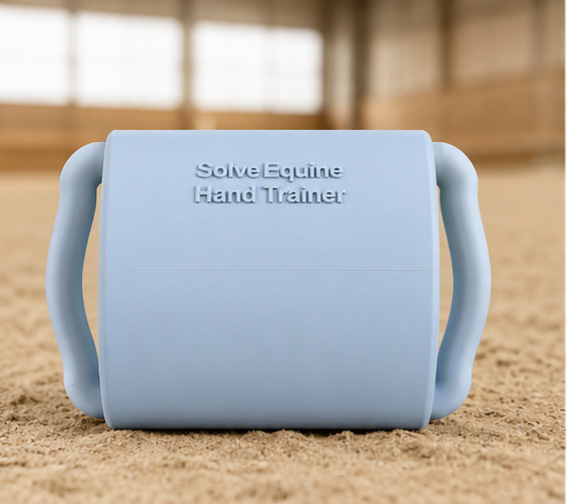
Designed with the rider in mind.
What Our SolvEquine Riders Are Saying
Better control of my hands.
Julie G.
Helps me realize I’m posting with my hands.
Linda K.
Made me realize I had bad habits I was deferring to instead of using my leg.
Debbie F.
Common questions
How do I hold and use the Hand Trainer?
Hold it with both hands while maintaining a normal riding position and rein contact. Keep your thumbs on top, wrists neutral, elbows soft, and hands centered and steady over the horse’s neck. The trainer gives you immediate feedback when your hands become uneven, too wide, or inconsistent.
Introduce it at the walk, then progress to posting trot, transitions, circles, serpentines, two-point work, and other exercises as you get comfortable. It can also be used off the horse to build muscle memory, including mimicking the posting motion while keeping your hands steady and correctly positioned.
How often should I use it?
Incorporate it into portions of every ride rather than the entire session. Even short periods of focused practice help reinforce steadier hands and better muscle memory. It can also be used between rides for off-horse practice.
Will it force my hands into one fixed position?
No. It is designed as a feedback tool, not a fixed restraint. It encourages soft, quiet hands while your arms and elbows continue to follow the horse’s movement naturally.
What is it made of, and what are the dimensions and weight?
It is made from a hard, durable, UV-resistant and crush-resistant plastic designed for use around the barn and arena. It measures approximately 9.5" across x 7.5" tall x 4.5" wide and weighs less than one pound.
Can it get wet? How do I clean it?
Yes. The Hand Trainer is fully waterproof and UV resistant, so normal exposure to rain, arena conditions, and barn environments is not a problem. Wipe it down or wash it with soap and water as needed.
What comes with my order?
Every Hand Trainer comes with the Arena Guide, a step-by-step instructional guide with more information to get the best use of your Hand Trainer, plus video instruction to help you get started.
What kind of riding can I use it for?
Flatwork, transitions, circles, serpentines, lateral work, pole exercises, and two-point work are all a good fit.
Is this only for individual riders, or can trainers use it too?
Both. It is useful for individual riders working on their own feel, and for instructors working with students.